
Operationalizing AI: A Business Leader's Guide to Smart Integration
Artificial Intelligence has moved beyond experimental chat tabs. For companies looking to build sustainable value, the focus has shifted to custom integrations that connect models to internal databases, systems, and client flows.
1. De-hyping AI: ML, LLMs, and Agents
To make intelligent technology decisions, it is critical to distinguish between the three primary categories of modern AI:
- Machine Learning (ML): Algorithms trained to classify structures or forecast metrics based on mathematical trends. Ideal for churn prediction or fraud detection.
- Large Language Models (LLMs): Foundation neural networks trained on vast textual datasets, enabling text summaries, structural translation, and conversational interfaces.
- Autonomous Agents: Core programs that use LLMs as reasoning controllers, prompting them to execute commands, invoke external APIs, scan documentation, and coordinate systems without human keypresses.
2. How Retrieval-Augmented Generation (RAG) Solves Hallucinations
By default, standard public models lack knowledge of your proprietary client records, contracts, or schedules. Standard fine-tuning is expensive, slow to build, and struggles with fast-changing values.
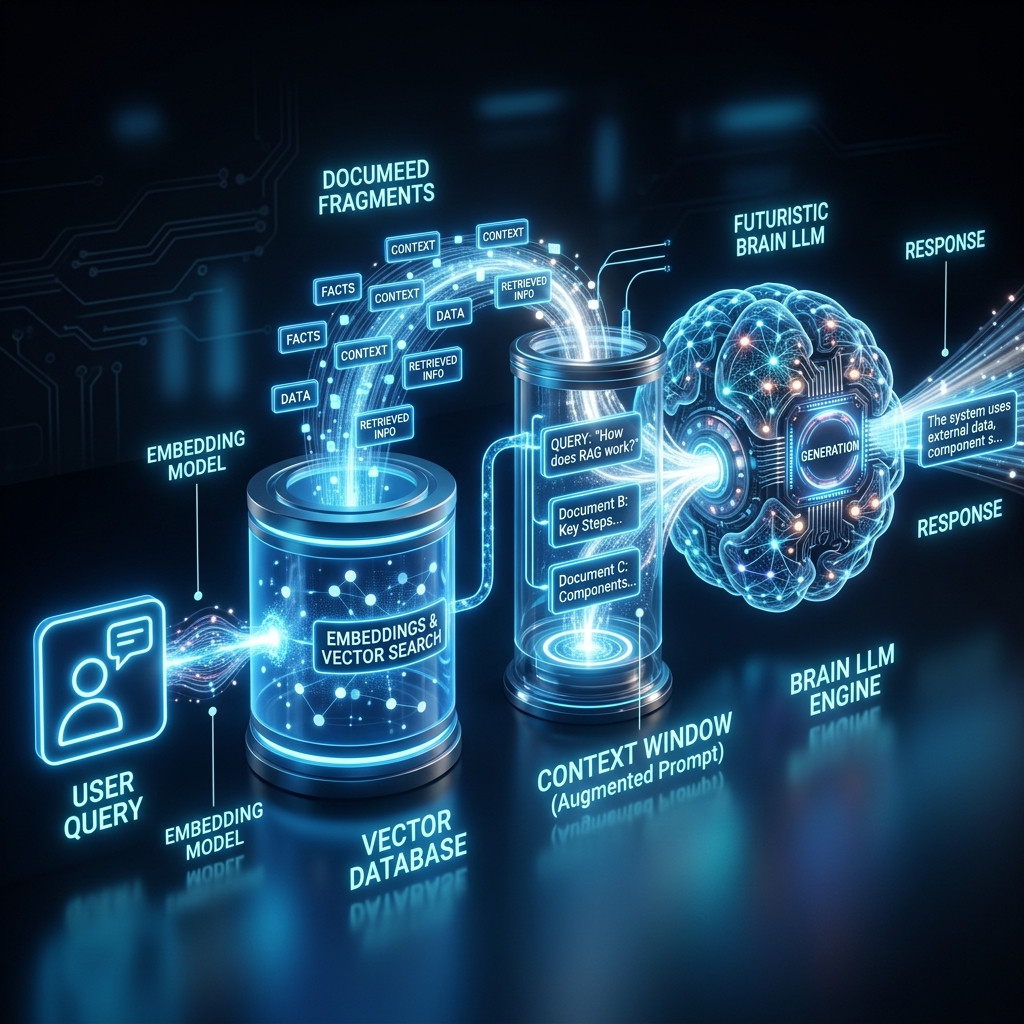
Retrieval-Augmented Generation (RAG) patches this limit by keeping models frozen while feeding them contextual snippets relevant to a user's question. This is achieved by:
- Converting files, articles, and database tables into vector tokens (embeddings).
- Storing these tokens inside high-speed vector index databases (pgvector, Pinecone).
- When a user asks a question, scanning the database for the most mathematically similar matches.
- Feeding those exact matched segments as a reference context window directly into the LLM prompt.
This architecture ensures the model's responses remain precise, secure, and referenced to your actual system files, completely eliminating hallucinations.
3. The Devora Tech Studio AI Blueprint
At Devora Tech Studio, we design custom corporate AI systems focusing on three architectural criteria:
- Data Privacy: Configuring isolated cloud nodes so that your company data is never used to train public models.
- Low Latency Caching: Building vector query routers and database caching layers to provide sub-20ms interactions.
- Reliable Workflows: Utilizing orchestration frameworks like LangChain and LlamaIndex to guarantee that AI agents follow strict process steps and call APIs correctly.
Summary for Decision Makers
Implementing AI successfully requires mapping manual bottle-necks (such as support ticket categorization, document drafting, or dashboard metric aggregation) and integrating targeted models through secure, standard-compliant APIs.