
Designing SaaS Architectures: Tenant Isolation & Scale Tactics
Building software that serves a single customer is relatively straightforward. Scaling a Software-as-a-Service (SaaS) platform that serves thousands of companies concurrently—while keeping their datasets isolated, secure, and fast—requires deliberate system choices.
1. Choosing a Multi-Tenant Database Strategy
The primary architectural decision when starting a SaaS project is how database layers are shared among different companies (tenants):
- Database-per-Tenant (Isolated): Each tenant receives a completely separate physical database instance. This provides maximum security and custom backup patterns, but adds high server overhead and configuration complexity.
- Shared Database, Shared Schema (Logical Separation): All tenants reside in the same database table, separated logically by a column (e.g. `tenant_id`). Highly cost-effective and easy to scale initially, but carries a small risk of data leaks if query filtering logic is configured incorrectly.
- Shared Database, Separate Schemas (Hybrid): Tenants share a single database server but are placed in distinct database schemas (PostgreSQL schemas). This strikes a beautiful balance between security isolation and server utilization.
2. Eliminating Bottlenecks with Redis Caching
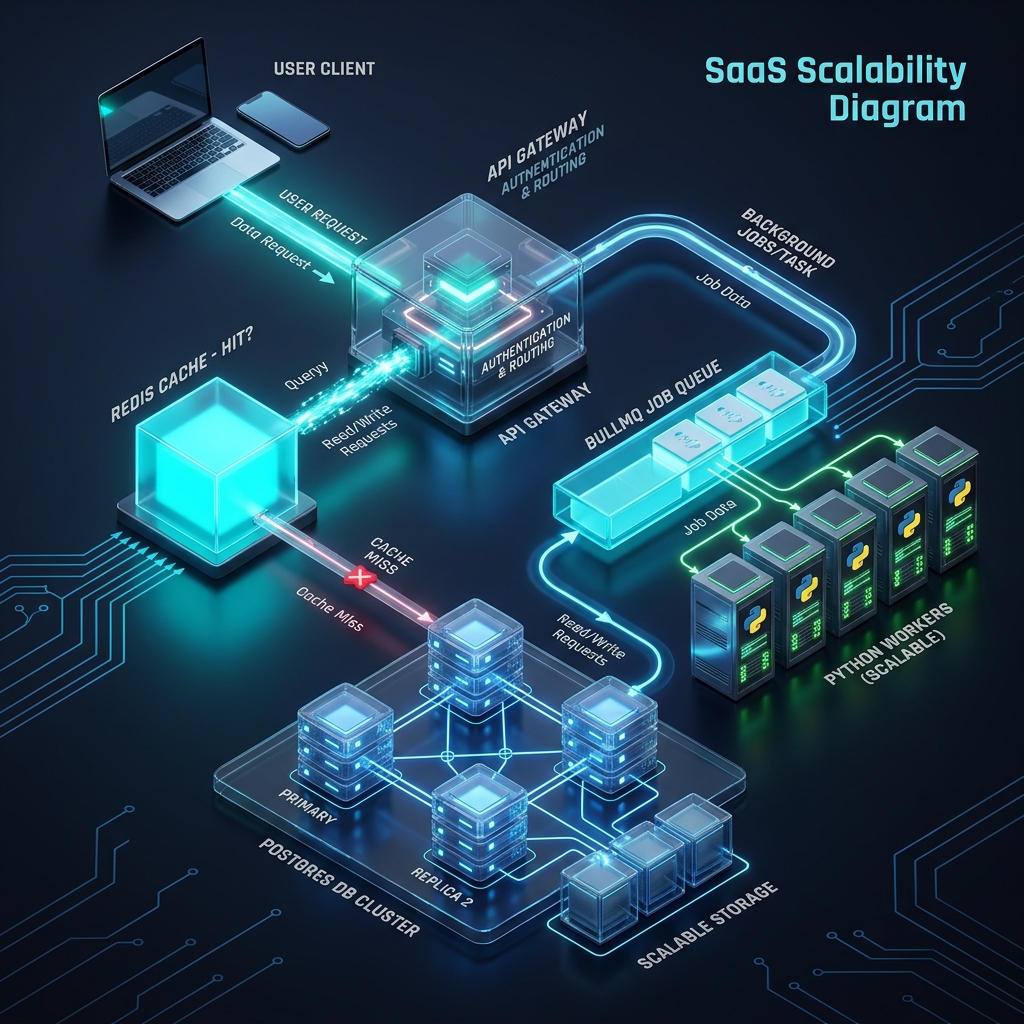
In a typical SaaS dashboard, users perform repetitive queries (such as retrieving client lists, configuration data, and current user parameters). Querying relational databases like PostgreSQL for every page load triggers unnecessary CPU locks.
By placing an in-memory database like Redis in front of your primary database, you can cache parsed JSON outputs with specific TTL parameters. This offloads up to 80% of read traffic, bringing dashboard load times under 30ms.
3. Background Task Offloading with BullMQ & Celery
When a SaaS user clicks a button to export a large PDF report, process an invoice payment via Stripe, or sync thousands of rows of inventory, processing this inside the main API execution thread will freeze the UI.
A robust SaaS architecture uses asynchronous worker queues:
- The API router quickly records the request and pushes a minimal payload to a task queue.
- The server immediately returns a success status back to the client UI ("Processing started...").
- Background workers (written in Python or Node.js) listen to the queue and execute the calculation.
- Once done, a WebSocket notification triggers in the dashboard to inform the user.
Scale Predictably
By decoupling HTTP request routing, caching layers, and heavy compute workers, you build SaaS platforms that scale predictably regardless of sudden customer expansion.